Friday, June 13, 2014

Hydrophis belcheri

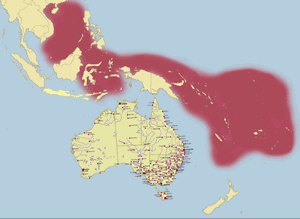
Taxonomy and BiologyAdult Length: 0.80 mGeneral Shape
Medium in length, slender bodied snake. Slender and elongated neck and anterior body increasing to a thicker mid and posterior body. Tail compressed laterally. Can grow to a maximum of about 1.22 metres. Head is small to medium, elongate and indistinct from neck. Dorsal scales are smooth and imbricate. Ventral scales are scarcely wider than adjacent dorsal scales and undivided ( some posterior ventrals may be divided ). About 23 to 29 scale rows around the neck.Habitat
Marine.Prey
Feeds mainly on eels and fish.Back to topSpecies MapSmall (Approx 20k) versionBack to top VenomGeneral: Venom Neurotoxins
Postsynaptic neurotoxinsGeneral: Venom Myotoxins
Probably present, but not confirmed.General: Venom Procoagulants
Not presentGeneral: Venom Anticoagulants
Not presentGeneral: Venom Haemorrhagins
Not presentGeneral: Venom Nephrotoxins
Secondary nephrotoxicity onlyGeneral: Venom Cardiotoxins
Secondary cardiotoxicity onlyGeneral: Venom Necrotoxins
Not presentGeneral: Venom Other
Not present or not significantBack to top Clinical EffectsGeneral: Dangerousness
Clinical effects uncertain, but related to medically important species, therefore major envenoming cannot be excluded.General: Rate of Envenoming: UnknownGeneral: Untreated Lethality Rate: UnknownGeneral: Local Effects
None or minimalGeneral: Local Necrosis
Not likely to occurGeneral: General Systemic Effects
Variable non-specific effects which may include headache, nausea, vomiting, abdominal pain, diarrhoea, dizziness, collapse or convulsionsGeneral: Neurotoxic Paralysis
No clinical reports for this species, but related species cause flaccid paralysisGeneral: Myotoxicity
No case reports for this species, but related species can cause systemic myolysisGeneral: Coagulopathy & Haemorrhages
Unlikely to occurGeneral: Renal Damage
No case reports for this species, but related species can cause renal failure secondary to myolysis.General: Cardiotoxicity
No case reports for this species, but related species can cause hyperkalaemic cardiotoxicity secondary to myolysis.General: Other
Insufficient clinical reports to knowBack to top First AidDescription: First aid for bites by Elapid snakes which do not cause significant injury at the bite site (see Comments for partial listing), but which may have the potential to cause significant general (systemic) effects, such as paralysis, muscle damage, or bleeding.Details
1. After ensuring the patient and onlookers have moved out of range of further strikes by the snake, the bitten person should be reassured and persuaded to lie down and remain still. Many will be terrified, fearing sudden death and, in this mood, they may behave irrationally or even hysterically. The basis for reassurance is the fact that many venomous bites do not result in envenoming, the relatively slow progression to severe envenoming (hours following elapid bites, days following viper bites) and the effectiveness of modern medical treatment. 
2. The bite wound should not be tampered with in any way. Wiping it once with a damp cloth to remove surface venom is unlikely to do much harm (or good) but the wound must not be massaged. For Australian snakes only, do not wash or clean the wound in any way, as this may interfere with later venom detection once in a hospital.
3. All rings or other jewellery on the bitten limb, especially on fingers, should be removed, as they may act as tourniquets if oedema develops. 
4. If the bite is on a limb, a broad bandage (even torn strips of clothing or pantyhose) should be applied over the bitten area at moderate pressure (as for a sprain; not so tight circulation is impaired), then extended to cover as much of the bitten limb as possible, including fingers or toes, going over the top of clothing rather than risking excessive limb movement by removing clothing. The bitten limb should then be immobilised as effectively as possible using an extemporised splint or sling. 
5. If there is any impairment of vital functions, such as problems with respiration, airway, circulation, heart function, these must be supported as a priority. In particular, for bites causing flaccid paralysis, including respiratory paralysis, both airway and respiration may be impaired, requiring urgent and prolonged treatment, which may include the mouth to mask (mouth to mouth) technique of expired air transfer. Seek urgent medical attention.
6. Do not use Tourniquets, cut, suck or scarify the wound or apply chemicals or electric shock.
7. Avoid peroral intake, absolutely no alcohol. No sedatives outside hospital. If there will be considerable delay before reaching medical aid, measured in several hours to days, then give clear fluids by mouth to prevent dehydration.
8. If the offending snake has been killed it should be brought with the patient for identification (only relevant in areas where there are more than one naturally occurring venomous snake species), but be careful to avoid touching the head, as even a dead snake can envenom. No attempt should be made to pursue the snake into the undergrowth as this will risk further bites.
9. The snakebite victim should be transported as quickly and as passively as possible to the nearest place where they can be seen by a medically-trained person (health station, dispensary, clinic or hospital). The bitten limb must not be exercised as muscular contraction will promote systemic absorption of venom. If no motor vehicle or boat is available, the patient can be carried on a stretcher or hurdle, on the pillion or crossbar of a bicycle or on someone's back. 
10. Most traditional, and many of the more recently fashionable, first aid measures are useless and potentially dangerous. These include local cauterization, incision, excision, amputation, suction by mouth, vacuum pump or syringe, combined incision and suction ("venom-ex" apparatus), injection or instillation of compounds such as potassium permanganate, phenol (carbolic soap) and trypsin, application of electric shocks or ice (cryotherapy), use of traditional herbal, folk and other remedies including the ingestion of emetic plant products and parts of the snake, multiple incisions, tattooing and so on.Back to top TreatmentTreatment Summary
Sea snake bites vary from trivial to lethal envenoming, so urgently assess all cases, looking especially for paralysis and/or myolysis. These usually develop in first 6 hrs. They require good hydration/renal flow, respiratory support (for respiratory paralysis), IV antivenom (CSL Sea Snake AV).Key Diagnostic Features
Minimal local pain, development over several hours of flaccid paralysis and/or myolysisGeneral Approach to Management
All cases should be treated as urgent & potentially lethal. Rapid assessment & commencement of treatment including appropriate antivenom (if indicated & available) is mandatory. Admit all cases.Antivenom Therapy
Antivenom is the key treatment for systemic envenoming. Multiple doses may be required.Back to topAntivenoms1. Antivenom Code: MAuCSL03Antivenom Name: Sea snake antivenomManufacturer: CSL LimitedPhone: ++61-3-9389-1911
Toll free: 1800 642 865Address: 45 Poplar Road
Parkville
Victoria 3052Country: Australia


Monday, September 30, 2013

King Cobra

Common Name: King Cobra

Scientific Name: Ophiophagus hannah

Type: Reptiles

Diet: Carnivores

Group Name: Quiver

Average Lifespan in The Wild: 20 years

Size: 13 ft (4 m)

Weight: Up to 20 lbs (9 kg)

Size relative to a 6-ft (2-m) man:

About the King Cobra

It seems unfairly menacing that a snake that can literally "stand up" and look a full-grown person in the eye would also be among the most venomous on the planet, but that describes the famous king cobra.

King cobras can reach 18 feet (5.5 meters) in length, making them the longest of all venomous snakes. When confronted, they can raise up to one-third of their bodies straight off the ground and still move forward to attack. They will also flare out their iconic hoods and emit a bone-chilling hiss that sounds almost like a growling dog.

Venom

Their venom is not the most potent among venomous snakes, but the amount of neurotoxin they can deliver in a single bite—up to two-tenths of a fluid ounce (seven milliliters)—is enough to kill 20 people, or even an elephant. Fortunately, king cobras are shy and will avoid humans whenever possible, but they are fiercely aggressive when cornered.

Habitat and Behavior

King cobras live mainly in the rain forests and plains of India, southern China, and Southeast Asia, and their coloring can vary greatly from region to region. They are comfortable in the trees, on land, and in water, feeding mainly on other snakes, venomous and nonvenomous. They will also eat lizards, eggs, and small mammals.

They are the only snakes in the world that build nests for their eggs, which they guard ferociously until the hatchlings emerge.

King cobras may be best known as the species of choice for the snake charmers of South Asia. Although cobras can hear, they are actually deaf to ambient noises, sensing ground vibrations instead. The charmer's flute entices the cobra by its shape and movement, not by the music it emits.

Did You Know?

The king cobra produces enough neurotoxin to kill an elephant with a single bite.


Sunday, August 25, 2013

Fer-de-lance


Fer-de-lanceany of several extremely venomous snakes of the viper family (Viperidae) found in diverse habitats from cultivated lands to forests throughout tropical America and tropical Asia. The fer-de-lance, known in Spanish as barba amarilla (“yellow chin”), is a pit viper (subfamily Crotalinae)—i.e., distinguished by a small sensory pit between each eye and nostril. It has a broad triangular head and is usually about 1.2 to 2 metres (4 to 7 feet) long. It is gray or brown, marked by a series of black-edged diamonds often bordered in a lighter colour. Its bite can be fatal to humans.


The common French name fer-de-lance, or “lance head,” originally referred to the Martinique lancehead (Bothrops lanceolatus) found on the island of the same name in the West Indies. Several authoritative sources, however, frequently apply the name to the terciopelo (B. asper) and the common lancehead (B. atrox) of South America. The name fer-de-lance has also been used collectively to describe all snakes of the Central and South American genus Bothrops and the Asian genus Trimeresurus.Among these snakes, all venomous, are the habus (T. flavoviridis and related species, such as Wagler’s pit viper [T. wagleri]); the jararaca (B. jararaca); the wutu, or urutu (B. alternatus); and the jumping viper, or tommygoff (B. nummifera).


Jararaca (Bothrops jararaca).

Dade Thornton—The National Audubon Society Collection/Photo Researchers

Wagler’s pit viper (Trimeresurus wagleri).

Copyright © 1971 Z. Leszczynski/Animals Animals

The Okinawa habu (T. flavoviridis) is a large, aggressive snake found on the Amami and Okinawa island chains in the Ryukyu Islands, often in human dwellings. It is usually about 1.5 metres (5 feet) long and is marked with bold, dark green blotches that may merge to form a wavy longitudinal band. Its venom is not especially potent but sometimes causes disability or death.

The jararaca, or yarará, is found chiefly in Brazil, where it is abundant in grassy regions. Its bite causes many deaths. It usually grows to about 1.2 metres (4 feet) and is olive-brown or grayish brown with darker brown blotches. In Argentina the name yarará also serves as an alternative name for the wutu and the Patagonian lancehead (B. ammodytoides). The wutu, a dangerous South American snake, is about 1.2 metres long. It is brown, boldly marked on its sides with thick dark semicircles outlined in yellow.

The jumping viper is an aggressive brown or gray Central American snake with diamond-shaped crosswise markings on its back. It is usually about 60 cm (2 feet) long. It strikes so energetically that it may lift itself off the ground. Its venom, however, is not especially dangerous to humans.


Saturday, June 15, 2013

Black Mamba

e Black Mamba is the most deadly snake in the world. They grow 14 feet in length, and can travel at speeds of up to 12 mph. They have a head shaped like a coffin. The Black Mamba is not actually black. They have a brownish-gray body with a light belly and brownish scales along its back. It gets its name from the color of the lining of its mouth, which is purple-black, and which it displays when threatened.


The Black Mamba lives in South Africa. They like open, low habitats such as savannas, rocky places and open woodlands. They are active during the day. They often sleep in hollow trees, burrows, rock crevices, or empty termite mounds, and will come back to the same place every night.

The Black Mambas feed on small mammals and birds, like voles, rats, squirrels, mice, rats, or bush babies. Once a Mamba was found with a parrot in its stomach, another with a full grown Forest Cobra! It will strike a large animal and then release it. It then stalks their victim until it becomes paralyzed. With smaller animals it will strike and hold on until the animal becomes paralyzed. Its flexible jaws and scales makes it possible to eat the animal whole.

Several weeks after a pair of mamba mate, the female will find a good place to lay 6-17 eggs. The burrow must be damp but not wet, and warm, but not too hot. After she lays her eggs the female leaves. The young snakes are about 16-24 inches long when they hatch three months later. They reach maturity when they are 3-4 feet in length.

The Black Mambas are found in pairs or small groups. They are very nervous, and head away fast when a human approaches. When the mamba feels threatened it will raise its front and head about 3-4 feet off the ground, open its mouth, spread a flat hood, and shake its head. When they attack they will make several quick strikes, and escape as fast as they can. They can strike from 4-6 feet away. Before antivenins were developed, a black mamba bite was 100% fatal.

They are invulnerable, because no animal can actually kill them. Their venom can kill just about anything, so they don't have much to worry about. The mamba is mainly threatened by habitat destruction.

by Allison F.  2000.


Wednesday, May 29, 2013

HOW DANGEROUS ARE COPPERHEAD SNAKES?

A Copperhead snake bite needs medical attention, is extremely painful, and may cause extensive scarring and loss of use. Many people are bitten while trying to kill or handle the snake. Don't take chances -- avoid these snakes.

"Copperhead bites are typically not fatal," says Dr. Peter Bromley, N. C. Cooperative Extension Specialist in Zoology. Small animals, like small dogs, may receive a fatal bite from a copperhead. The venom causes local tissue destruction and secondary infection often sets in. If you or your pet are bitten by any snake that you suspect is venomous, get medial attention immediately. For the most part, if you let snakes alone, they'll leave you alone.

North Carolina has the dubious distinction of the most venomous snake bites of any state in the U.S. Many of these bites could be prevented by avoiding the snake instead of trying to kill it or pick it up. Avoid Copperhead snakes! Allow it to go on its way undisturbed. Copperheads bite more people in most years than any other U.S. species, but they also have the mildest venom. University of Georgia Professor Dr. Whit Gibbons is conducting research to learn why copperheads inflict the most bites.

All the snake species tested have had the same initial response to human presence. If given the opportunity, they escape--down a hole, under a ledge, or in the case of cottonmouths, into the water. Escape is even the standard behavior of enormous diamondback rattlesnakes, which will immediately disappear if they have enough warning before they think a person can reach them.

But often escape is not possible, so most snakes hold their ground, ready to defend themselves. A difference between copperheads and the other species appears in the next phase, when they are approached. Most rattlesnakes vibrate their tails and most cottonmouths sit with mouth open when a human comes near. Even some non-venomous snakes vibrate their tails. These displays are merely warnings not to tread on them. They are not aggressive attack measures. The snakes just want us to leave them alone.

So far, the dozens of cottonmouths Dr. Gibbons stood beside have made threat displays but have not bitten the researcher's boot. The same has been true for canebrake rattlesnakes although too few have been tested to declare that they are as passive as cottonmouths. The exciting news (at least for the researchers) is that the copperhead is different from the others. Most copperheads tested have struck out immediately when they felt threatened.

This behavior explains why more people receive legitimate snakebites from copperheads than from any other species of venomous snake in North America. Still to be investigated is another aspect of copperhead bites: many are not serious enough to require more than minor medical treatment. This may be so not only because the venom of a copperhead is significantly less potent than that of rattlesnakes or cottonmouths, but also because they seldom inject much venom.

The copperhead's initial threat display is to strike. It lashes out at an enemy as a warning. If the enemy is close enough, the fangs may penetrate the skin. However, because this is a threat display, not an attempt to kill, the snake injects little venom. A copperhead has no intention of wasting valuable venom if it can scare away the menace with a minor bite.

Keep in mind, however, that even a non-fatal bite needs medical attention, is extremely painful, and may cause extensive scarring and loss of use. Don't take chances-- avoid these snakes.

Whit Gibbons is the Senior Professor of Ecology at the University of Georgia's Savannah River Ecology Laboratory in Aiken, South Carolina.


Friday, May 24, 2013

Snake Venom: Bungarotoxins

Venom: an arsenal of toxins


Many-banded krait

Venomous snakes are found throughout the world; they are even lurking in our oceans.  Said to cause over 3 million bites a year worldwide, they pose a significant health problem both in mortality and morbidity, causing amputations and renal failure, in addition to over 100,000 deaths a year.  The major culprits are vipers, elapids, colubrids and sea snakes.  Of these, elapids such as cobras and kraits have developed the most potent toxins.  Snake venoms contain a multitude of biologically active toxins that work together for the capture of prey (take a look at the Table listing the variety of toxins found in the venom of the many-banded krait).  Their effects include pro- and anti-blood coagulation, neurotoxicity, mycotoxicity, nephrotoxicity, cardiotoxicity and necrotoxicity (local tissue damage). Amongst these, the neurotoxins play a key role in immobilising prey through paralysis, disorientation and depressed respiration.

            Venoms often contain different neurotoxins that work synergistically to cripple the nervous system.  Neurotoxins can be classified according to their site of action: pre-synaptic neurotoxins block neurotransmission by affecting acetylcholine transmitter release; post-synaptic neurotoxins are antagonists of the acetylcholine receptor.  Together these neurotoxins effectively block skeletal neuromuscular transmission by crippling receptors, while at the same time acting to destroy any neurotransmitter that might compete with the toxin for receptor binding.  Venoms often contain several post-synaptic neurotoxins, each with a high affinity for a nicotinic receptor subtype - in this way the venom can cripple as many receptors as possible.  The post-synaptic neurotoxins are found only in elapids and sea snakes (Hydrophiidae).  In the many-banded krait pictured above, a pre-synaptic toxin is b-bungarotoxin, while post-synaptic toxins are a‑ and k-bungarotoxins. 


Milking a snake

Photographs courtesy of B. G. Fry, Australian Venom Research Unit, Melbourne, Australia


Tuesday, March 12, 2013

Gaboon Viper

The West African gaboon viper or (Bitis Gabonica) is the largest out of all the old world vipers. There have been individuals found up to 7 feet but an average of 6 feet is more common. They are also one of the most beautiful of all snakes. In the wild their strikingly marked bodies are near impossible to see among the ground and leaf litter. These guys are ambush predators that sit and wait for a meal to come walking through the game trail. They have the largest fangs of any venomous snake in the world. The fangs can grow up to two inches in length. Their natural habitat consists of dense forested areas and humid grassy areas.
LOCALITY

The West African gaboon viper inhabits Guinea, The Ivory Coast, Togo, Ghana, Cameroon, Benin, Angola, The Congo, and Gabon.

CAPTIVE HUSBANDRY

Keeping bitis species can be a very rewarding species to keep as long as every single requirement is met in order to keep them healthy and thriving. Correct temperature and humidity levels MUST be maintained and monitored every day.

TEMPERATURES

They live in tropical forests and do not do well in hot climates. They like it on the cool side. In some part of their range they almost never see direct sunlight in the wild.

DAY TIME TEMPS

On the cool end of the cage temps should be between 70 and 75 degrees.

On the warm end of the cage the temps should be between 75 to 85 degrees, maximum.

Temps at night can drop 5 to 8 degrees. I use light bulbs to heat the cage during the day and nothing at all for the night time. You can offer your animal a basking spot but they will hardly if ever use it.

HUMIDITY

The humidity levels for this species should be between 60% to 80%. You can allow it to drop a little if you will be cycling them for breeding…… This can only go on for a short period of time. Bitis’ can dehydrate very quickly. Too much humidity without proper ventilation can cause scale rot and upper respiratory infections. Too little and you will wind up with very jerky snake.

 HYDRATION

As mentioned above, the Bitis Gabonica can dehydrate very quickly. There are a few tricks I have learned over the years to keep them hydrated.

Always keep a clean supply of drinking water in the cage. Gaboons do not readily drink from standing water supplies but they will drink from one if they happen to stumble upon it in their travels.