Friday, May 13, 2016

REPTILES - RED BELLIED BLACK SNAKE

The venomous Red-Bellied Black Snake grows to lengths of up to two metres long, and has striking colouration. With stunning red edges to its belly scales and a shiny black back, this snake surely ranks amongst Australia's most stunning venomous snakes. The Red-Bellied Black snake is most active during the day, although they may also be seen on hotter evenings.

Habitat

The Red-Bellied Black Snake can be found inhabiting most forest types near permanent watercourses or swamps in eastern and south-east Australia.

Diet

The Red-Bellied Black Snake's diet consists of frogs, other reptiles and mammals. Usually seen around cool, wet areas the Red-Bellied Black Snake is particularly fond of frogs, making the Cane Toad a big problem. If they even bite a Cane Toad its all over. It's hard to believe that this beautiful snake could suffer so badly as the result of the introduction of one alien species.

Breeding

Mating occurs in spring with combat between rival males occurring in this period. During combat, the snakes bodies are intertwined with their heads raised. They do this in attempt to place their head higher than that of their opponent. When pregnant, female Red-Bellied Black snakes are known to aggregate and bask in the sun together. January to March is when between five and forty young are born in membranous sacs from which they emerge from shortly after birth.

Status

Local populations were almost driven to extinction by the introduction of the Cane Toad. If a snake tries to consume a toad, they will fall victim to the toad’s poisonous gland secretions. It does however appear now that some of these snakes are finally learning to avoid the Cane Toad and their numbers are beginning to recover.


Saturday, February 13, 2016

Golden lancehead

The Golden lancehead (Bothrops insularis) is a highly venomous pit viper species endemic to the Queimada Grande island or as it's known in colloquial English "Snake Island". ​

The island is located about 40 miles off the coast of Sao Paulo state, in Brazil and it's size is roughly around 110 acres. ​

 also uninhabited and travel to the island is forbidden by the Brazilian navy, and there is a good reason, it is home to hundreds of thousands of venomous golden lancehead snakes.

The island is a subtropical or tropical moist forest containing several different types of habitats including forest, clearings, and shrubs. The climate is very mild, and the temperatures never fall below 64ºF (18ºC), or over 72ºF (22ºC). 

They can usually be found seeking shelter among leaf litter or in rock crevices, especially during unfavorable weather or after having just ingested a prey. But are also found in the trees hunting for prey. The golden lancehead grows to an average length of 28 inches (70 cm) but it's known to reach 46 inches (118 cm) in maximum length.

The snake's color pattern consists of a series of triangular or quadrangular blotches, that may be broader or narrow, and alternating or opposite along the back overlaid in a pale yellowish brown ground color. The belly is a uniform pale cream or yellow, and they lack a well-defined post-orbital stripe. When in captivity, their yellowish color often becomes darker

Their common name "lancehead" refers to the distinctive head shape of all Bothrops genus snakes, which is elongated and comes to a point at the nose.

The golden lancehead has a longer tail than the Jararaca, its closest relative, which probably an adaptation to help them maneuver through the trees found in the island.

Venom / Bite

Since the golden lancehead only inhabits an area uninhabited by humans, there has never been a recorded bite by one, but other lancehead species are responsible for more human deaths than any other snakes in both North and South America.

The chemical analysis of their venom suggests that it's 5 times more potent than that of their cousin the jararaca, and is also the fastest acting venom in their genus. The mortality rate for other lancehead species envenomations is around 7%, if the victim doesn't receive medical treatment, but even if the patient receives treatment the bite is fatal on 3% of the cases. 

The effects of lancehead venom include local pain and swelling, nausea and vomiting, blood blisters, bruising, blood in the vomit and urine, intestinal bleeding, kidney failure, brain hemorrhage and severe necrosis of muscular tissue.

Lancehead snakes have an hemotoxic venom that eats away at flesh and tissue to help digest the prey before they swallow it, but the golden lancehead also has some neurotoxic components in their venom to help killing the prey.

Diet / Feeding

Their diet consists mostly of perching birds, but they have been reported to eat lizards or even resort to cannibalism. The newborn and juvenile snakes prey mainly upon invertebrates. Because there are no mammals native to the island Queimada Grande, this has undoubtedly had a profound impact on their evolution.

Reproduction

The golden lancehead mating season occurs during August and September, and these vipers are known to mate using both the ground or trees. Like most other viper species, the golden lancehead gives birth to live young.

The average litter size around 7 newborns, and there is no recorded data about their size at birth, but one would expect it be similar to that of the Jararaca (about 10 inches).

Conservation / Threats

In the IUCN Red List the golden lance head is classified as critically endangered, this is due to several factors, but the main threat to the species is the habitat destruction. In the past, fires were deliberately started on the island in an attempt to eradicate the snakes so it could be used for agriculture.

To maintain the lighthouse on the island, the Brazilian Navy has also contributed to habitat destruction by the removal of vegetation. The species was also plagued by over harvesting from scientists.

The island of Queimada Grande is the only place in which these snakes are found in the wild, but it can only support a limited snake population due to its small size of only 43 hectares.

This also leads to a large amount of inbreeding within the population and the occurrence of "intersexes" (specimens born with both male and female reproductive parts) this is harmful because most of the intersexes are born sterile

Did You Know?

The australian inland taipan  bite contains venom enough to kill up to 100 full grown men. 


Scientific classification

Kingdom: Animalia
Phylum: Chordata
Subphylum: Vertebrata
Class: Reptilia
Order: Squamata
Suborder: Serpentes
Family: Viperidae
Subfamily: Crotalinae
Genus: Bothrops
Species: B. insularis


Sunday, October 18, 2015

Eastern Brown Snake

Don’t let the innocuous name of this snake fool you, 1/14,000 of an ounce of its venom is enough to kill an adult human. Coming in a variety of species, the Eastern Brown snake is the most venomous. Unfortunately, its preferred habitat is also along the major population centers of Australia. The Brown snake is fast moving, can be aggressive under certain circumstances and has been known to chase aggressors and repeatedly strike at them. Even juveniles can kill a human. The venom contains both neurotoxins and blood coagulants. Fortunately for humans, less than half of bites contain venom and they prefer not to bite if at all possible. They react only to movement, so stand very still if you ever encounter one in the wild. [Image Source]


Wednesday, March 18, 2015

RHABDOPHIS TIGRINUS FORMOSANUS Asian Tiger Snake

FamilyColubridae, subfamily Natricinae


Max. length100 cm


Occurrence in Taiwan

Throughout Taiwan, at altitudes above 1500 m.Rare. (Distribution map)


Global Distribution

This subspecies is endemic to Taiwan.


Description


Small to medium-sized snake; total length up to 100 cm. There are 15-19 (17-19 at mid-body) rows of scales, all are strongly keeled. Head is oval and distinct from neck; body is moderately stout; tail is moderately long. Eye is medium to large; iris is dark brown and pupil is round, jet black, surrounded by ring of gray. Tongue is maroonish. The snake has a pair of nuchal glands and enlarged rear fangs (not directly connecting to venom glands). Upper head is olive at least anteriorly; there is a thick, curved cross band of yellow on the nape, to which a black cross band adjoins in the front and rear. The supralabials are yellow with black sutures, the black areas along the sutures below eye are broad. Upper body and tail bear green/yellow/orange and black spots arranged in alternating rows (totally 5 rows), creating a checkered appearance. Ventral head is whitish. Ventral scales on body and tail are blackish with (irregular) posterior margins of light green/yellow. Anal scale is divided and subcaudals are paired.


Biology & Ecology

This diurnal opistoglyphous (= rear-fanged, see footnote(1)) snake inhabits humid environments, including mountain rivers, creeks, and forest floors. It preys on frogs and toads, and occasionally on fish or snakes. Females produce 8-47 eggs per clutch in summer; hatchlings measure about 16 cm in total length. When threatened, the snake may rear its head and neck, and expand its neck transversely like a cobra.

This species is also the only known snake that is venomous and poisonous at the same time. (For the difference between the terms 'venomous' and 'poisonous' see footnote (2)).

Here's how:

POISON:

The defensive behavior of this snake is very unusual.When threatened by a predator, the snake arches its neck toward the attacker and releases the contents of paired nuchal glands that lie in the dorsal skin. The product of those glands is distasteful and irritating to the eyes and contains compounds similar to those found in the skin glands of toads. (Source)          

The origin of the poison in these glands is a highly interesting aspect of this species, and was explained for the first time in a 2007 study by Hutchinson et al.The study shows that Rhabdophis tigrinus becomes poisonous by sequestering toxins from its prey, which consists of venomous toads. The process allows the snakes to store in their neck glands some of the toxins from the toads they have eaten:

Analyzing differences between snakes living on toad-rich and toad-deficient islands in Japan, researchers led by Deborah A. Hutchinson of Old Dominion University in Norfold, Virginia, found that the Japanese grass snake or Yamakagashi, as the snake is known locally, did not manufacture its own venom, but instead relied on that found in toxic toads: the researchers found that snakes living on Japan’s toad-free island of Kinkazan lacked the toad’s toxic bufadienolide compounds completely. Snakes from Ishima, where toads are plentiful, had high levels of bufadienolides. R. tigrinus from Honshu, where toad numbers vary, displayed a wide range of bufadienolide concentrations. Feeding R. tigrinus hatchlings toad-rich and toad-free diets confirmed these results.

The study also found that snake mothers with high concentrations of the toxin are able to pass bufadienolide toxin on their offspring, helping protect them from predators. The Yamakagashi stores the sequestered toxins in 'a series of paired structures known as nuchal glands in the dorsal skin of the neck,' according to the researchers. When threatened, the snake takes a defensive position that exposes the toxin-containing nuchal glands to predators.

While sequestering defensive toxins from prey is unusual among terrestrial vertebrates, it is not unknown. Research published last year by Valerie C. Clark of Cornell University showed that poison dart frogs (Dendrobates species) and their Madagascar counterparts, the Mantella frogs, sequester toxic skin chemicals, called alkaloids, from the ants they eat. These alkaloids protect the frogs from predation. Similarly, some garter snakes are known to store tetrodotoxin from ingested newts while birds in New Guinea appear to sequester poisons from insects. (Source) 

The NewScientist notes:

What is more, when attacked, snakes on different islands react differently. On Ishima, snakes stand their ground and rely on the toxins in their nuchal glands to repel the predator. On Kinkazan, the snakes flee. 'Snakes on Kinkazan have evolved to use their nuchal glands in defence less often than other populations of snakes, presumably due to their lack of defensive compounds,' says Hutchinson. Moreover, baby snakes benefit too. The team showed that snake mothers with high toxin levels pass on the compounds to their offspring. Snake hatchlings thus also enjoy the toad-derived protection.

More details on this studycan be found here. The study itself, 'Dietary sequestration of defensive steroids in nuchal glands of the Asian snake Rhabdophis tigrinus' by Deborah A. Hutchinson, Akira Mori et al. is available here.


VENOM:

Many members of the family Colubridae that are considered venomous are essentially harmless to humans, because they either have small venom glands, relatively weak venom, or an inefficient system for venom delivery. While Rhabdophis tigrinus has small venom glands and delivers its venom inefficiently, saidvenom is certainly not weak.Although this snake is reluctant to bite, even defensively, the bite has been known to cause fatalities in humans. The venom acts very slowly, inhibiting the ability of the blood to clot and causing death by hemorrhage:

"Three cases of serious envenomation by this species are reported (in Japan), all marked by delayed, spontaneous, superficial hemorrhaging and profound impairment of normal blood coagulation. In two cases these phenomena were accompanied by signs of severe internal hemorrhaging and hemolysis. Other symptoms may have resulted from transitory involvement of the central and autonomic nervous systems. Therapeutic measures applied in these cases are described, including the apparently effective use of a systemic antihemorrhagic drug. It is concluded that R. tigrinus is a dangerously venomous snake and potentially lethal to man.(Source)

For this reason, the small colubrid snakes of the genus Rhabdophis have a shady past in the pet trade. Because they resemble certain harmless garter snake-like species, they were imported into the U.S. and U.K. under the wrong names, and ended up causing medically-significant emergencies when they bit their new owners. (Source)

The website www.toxinology.com provides a detailed breakdown of the contents and clinical effects of R. tigrinus' venom.


Etymology

Rhabdophis comes from the Greek words rhabdos,meaning "rod" or "wand", and ophis, meaning "snake";

tigrinus is Latin for "tigerlike";

formosanus denotes the distribution of this subspecies, namely the island of Taiwan (formerly Formosa).

The Chinese name 台灣赤煉蛇 means "Taiwan (台灣) Red (赤) Smelted (煉) Snake (蛇)".


Footnotes

(1) "Opisthoglyphous snakes are similar to aglyphous (fangless) snakes, but possess weak venom, which is injected by means of a pair of enlarged teeth at the back of the maxillae (upper jaw). These "fangs" typically point backwards rather than straight down, possess a groove which channels venom into the prey, and are located roughly halfway back in the mouth, which has led to the vernacular name of "rear-fanged snakes".(Source)

(2) The distinction between venom and poison

There is a difference between organisms that are venomous and those that are poisonous, two commonly confused terms applied to plant and animal life:

- Venomous...refers to animals that deliver (often, inject) venom into their prey when hunting or as a defense mechanism.

- Poisonous, on the other hand, describes plants or animals that are harmful when consumed or touched. A poison tends to be distributed over a large part of the body of the organism producing it, while venom is typically produced in organs specialized for the purpose(Source)


FURTHER INFO

Reptile Database

Wikipedia

Discussion of R. tigrinus on Dr. Bryan G. Fry's Venomdoc Forum

Taxonomic Status of the Taiwanese Populations of Rhabdophis tigrinus


Friday, March 6, 2015

Yellow-bellied sea snake (Pelamis platurus)

The Yellow-bellied sea snake has a paddle-shaped tail and distinctive colouring with a dark back contrasting with paler sides and belly in many patterns. Their average total length is around 1 metre.

Their geographic range is wider than that of any other reptile species, except for a few species of sea turtles. It extends from the east coast of Africa, from Djibouti in the north to Cape Town in the south, across the Indian Ocean, the Pacific, south as far as the northern coast of New Zealand, all the way to the western coast of the Americas, where it occurs from northern Peru in the south (including the Galápagos Islands) to the Gulf of California in the north.

This species lives in the surface layers of the open ocean and drifts passively in warm currents. It is quite helpless on land because their compressed shape makes them roll onto their side and sea snakes washed onto beaches during storms seldom manage to return to the sea.

They feed on small fish only, which they make immovable with their venom. The yellow-bellied sea snake is about ten times more venomous than the Egyptian cobra (Naja haje) but it delivers a much smaller quantity of venom per bite. They hunt by cautiously approaching their prey or by waiting motionless at the surface and ambushing fish that come to shelter underneath it. With its mouth open the snake makes a rapid sideways swipe to snare any fish that comes too close.

Unlike most other species of sea snake, the Yellow-bellied Sea Snake does not seem to have many predators. The bright colouration of this species serves as a warning, not only that the snake is highly venomous, but also unpleasant and possibly even toxic to ingest.

They are capable of bursts of speed of up to 1m/sec when diving, fleeing and feeding. When swimming rapidly, they sometime carry their head out of water.

Yellow-bellied Sea Snakes often are found in large numbers in long lines of marine debris. These “slicks” form in calm seas and consist variously of debris, foam and scum. In some areas, such as the Gulf of Panama in the eastern Pacific Ocean, the slicks can be from 1 to 300 m wide and many kilometers long. Several thousand snakes may be associated with a single slick.

Females give birth to 2 to 6 live young with a gestation period of about 6 months. The young (around 250 mm in total length) are born with substantial fat reserves but they will feed on their first day of life.

As Yellow-bellied Sea Snakes live in open waters they have little access to hard objects, such as coral, to rub against when the skin needs to be shed. Instead the snake uses a knotting behavior where it coils and twists upon itself, sometimes for hours on end, to loosen the old skin. The knotting behaviour also helps to remove organisms such as algae and barnacles attached to their skin.

Most sea snakes are able to respire through their skin. This is unusual for reptiles, because their skin is thick and scaly, but Yellow-bellied Sea Snakes can obtain 20% of its oxygen requirements in this manner, which allows for long dives.


Yellow-bellied sea snake
Image © HeterodonPA from Flickr


Yellow-bellied sea snake 
Image from Searunner


Tail of the Yellow-bellied sea snake 


Sunday, November 23, 2014

The Boomslang Snake Of Africa

On September 26, 1957, the herpetological world experienced a rude awakening when the eminent herpetologist, Karl P. Schmidt, died from a snake bite. The snake was a boomslang (Dispholidus typus), a species thought at the time to be harmless, even though it was a known rear-fanged species.


PAUL DONOVAN

Dispholidus typus is one of Africa's most venomous snakes.

Schmidt was a senior herpetologist at Chicago's Lincoln Park Zoo, and his knowledge of snakes was second to none. He was brought a bag containing a snake, and upon opening it and peering inside, he immediately identified it as a young boomslang. He removed the snake from the bag for closer examination, and it was during this examination that he sustained a bite to his thumb from a single fang. As rear-fanged snakes were not considered dangerous at the time, Schmidt had no cause for concern and went about his daily business. He made periodic notes regarding the effects of the snake's venom as they developed.


PAUL DONOVAN

The arboreal boomslang can frequently be found in isolated trees within open clearings.

The following day Schmidt returned to work, where he reported that he felt fine. By that afternoon, he was dead from respiratory arrest and cerebral hemorrhage. Schmidt's death changed our perception of the boomslang, and subsequent analysis of its venom found it to be as toxic, if not more toxic, than many front-fanged snakes. Today, the boomslang ranks as one of Africa's most venomous snakes.
My first introduction to D. typus came while working with the zoological collection at Chessington World of Adventures in Surrey, England. I visited a dealer to pick up snakes we had ordered, and he asked me if I could drop three boomslangs off at another customer's house on my way back. During the drive, I prayed that I wouldn't have an accident because the car was full of venomous snakes. In addition to the boomslangs, there were two king cobras, a green mamba, three rhino vipers and a couple of Gaboon vipers. At my destination, when we released the boomslangs into their cage, I was surprised by their placidity. I expected them to fly around the cage like mambas do when first released. The boomslangs throat-displayed for a while, then settled down. It was after that experience, sometime later, that I managed to buy a couple boomslangs for myself, and my affinity for this misunderstood snake truly began.

Lurking Fear

Since Schmidt's untimely death, the boomslang is on record as having caused the deaths of seven people. Seven in 54 years is not a high figure when compared to deaths caused by other venomous snakes. One reason boomslang-related deaths are few and far between is likely because, contrary to much speculation, the boomslang is a shy snake and bites only when threatened.

I live in Botswana, and I am married to a local girl. The fear locals have for this snake nearly outweighs all others. They believe that if you walk past a bush or beneath a tree harboring a boomslang, the snake will either bite you in the face or drop onto your head to bite you. If you park your car near a bush containing a boomslang, and if you leave any windows open, the snake will crawl inside.

I lecture about snakes at various educational and government facilities throughout Botswana, and even though there have been no reported deaths attributed to boomslangs in that country, it is extremely difficult to change the locals' deep-set beliefs surrounding this snake. They remain fearful even when I tell them that virtually all boomslang bites were inflicted on inexperienced snake handlers, and not locals as they went about their business. In fact, this is a snake that once it detects your presence, it will be long gone before you even knew it was there. Problems arise when people - particularly children - see a boomslang and try to kill it.

Having the good fortune to have been able to search for boomslangs in the wild, the one thing I have learned is that it is a shy, elusive snake that is extremely difficult to locate, let alone catch. It is a very mobile snake, always on the move, and very agile. I also rescue snakes from people's homes before they are battered to death with a shovel, and I've been called out to remove the odd boomslang from someone's yard. I have never found it to be an aggressive snake, and when approached it will move away to avoid confrontation. One minute you are looking at it square in the face, but if you blink, you've lost it. However, as soon as you show any inclination to capture it, it will put up an impressive warning display to get you to back off. It is a challenging snake to capture.

Boomslang Description

The boomslang is not a large snake; it averages between 3 and 5 feet, though in exceptional cases in some parts of its range, it may exceed 6 feet. It has a rather slender, laterally compressed body with large, heavily keeled, overlapping scales. It is arboreal and widely distributed over much of sub-Saharan Africa, where it occurs in a range of habitats from coastal thickets to dry savannah, and even semi-desert areas. It is not typically found in densely wooded areas, preferring instead more open areas. In fact, boomslangs can frequently be encountered in isolated trees within open clearings.

Depending on age, sex and locality, the boomslang exhibits a broad range of color forms. Adult dorsal coloration may be gray, green, black or yellow. Mottling is sometimes present, and occasionally, pinkish-red boomslangs are also seen. The underbelly is off-white, yellowish or pale brown with or without spots. Young individuals are usually gray or brown with dark and light spots of bluish hue, and a yellowish or pinkish underbelly with varying shades of brown spots.

Boomslangs are one of the few snake species where sexual dimorphism is evident. Females are almost always brown, whereas males exhibit more vibrant coloration. It is difficult to understand why this sexual dimorphism should occur, as it is not seen in other arboreal snakes, such as bush snakes (Philothamnus) or mambas (Dendroaspis), that frequent similar habitat across some of the boomslang's range.

The interstitial skin (the skin between the scales) of the neck is black and most apparent when the snake inflates the neck region during warning displays. Young green-phase boomslangs may often be mistaken by the layman for green mambas (although these do not occur in Botswana) or harmless bush snakes. The foremost identification feature distinguishing the boomslang from other arboreal snakes is the large, prominent eyes (which are iridescent green in young snakes), and a rather squat, somewhat chisel-shaped head.

The boomslang's eyes account for a great proportion of the head's overall dimensions. The pupils are neither circular nor catlike, as seen in other arboreal snakes. They more closely resemble a keyhole or dumb-bell shape with a yellow iris. The large eyes of the boomslang indicate superior vision, believed to be binocular, and they can spot their prey before it moves. The large eyes would also lead one to believe the snake to be a nocturnal species, but it is diurnal, being most active during the early afternoon.

Feeding and Threat Behaviors

To watch a boomslang stalk its prey is riveting. It feeds on tree-dwelling lizards, especially chameleons (in Botswana, this includes the flap-necked chameleon, Chamaeleo dilepis), as well as birds and small rodents. When the snake detects its quarry, it moves slowly toward it, stopping periodically, presumably if it thinks it's been spotted. During these brief pauses, the boomslang may sway gently to appear as though it were a branch wafting in the breeze. It moves slowly forward until it's within striking range of its prey.

Like mambas, boomslangs frequent trees where weaverbirds construct congregational nests, so that they may raid the nests and snatch their tenants. I am not sure if it is common among boomslangs - it is not mentioned in the literature - but I know of one specimen that would eat the eggs of the weaverbirds. I captured this particular snake, and it regurgitated two eggs as I removed it from a weaverbird nest.


PAUL DONOVAN

Boomslangs are proteroglyphous (rear-fanged or back-fanged) snakes.

Although essentially an arboreal snake, boomslangs will descend to the ground or even cross water and roads in their quest for prey, but they always return to the trees to consume it. Most of the individuals I have encountered seem to have a penchant for thorny bushes, which makes capture doubly difficult.

As mentioned, when provoked, a boomslang can exhibit a very convincing threat response. It inflates its neck and the forepart of the body, displaying the contrasting interstitial skin. This is a different type of display than that seen in cobras, as the neck is not inflated by compression of the ribs, but an expansion of the throat. At the same time, the tongue moves up and down in a slow, deliberate motion. If this warning is disregarded, the boomslang may administer a swift sideways-motion bite, after which the snake may move off, or it may retain its threat posture until the perceived threat has passed.


PAUL DONOVAN

The boomslang averages between 3 and 5 feet, but in exceptional cases in some parts of its range, it may exceed 6 feet.

Venom and Venom Delivery

Boomslangs are proteroglyphous (rear-fanged or back-fanged) snakes, which means that they have enlarged teeth at the rear of the jaws with which to transfer their venom into prey. Most rear-fanged snakes have relatively short fangs with a channel running down their outer edge through which the venom trickles. Therefore, they typically need to "chew" their venom into their prey while holding it in their mouths. Boomslangs differ in having significantly longer fangs, and they can open their mouths wide enough (to 170 degrees) to facilitate a bite to the arm or leg. The boomslang's bite is reminiscent of the stabbing motion delivered by front-fanged snakes, and it negates the need for chewing action.

Boomslang venom is hemotoxic with coagulopathic properties, causing hemorrhaging to the gums, nose and other orifices, as well as existing cuts. Even a glancing scratch will bleed profusely. It is a slow-acting venom, and more often than not, it may take several hours, perhaps even a day, before the effects of the venom begin to manifest themselves in a human. Visible signs of boomslang envenomation include blood being passed in the stool, urine, saliva or vomit. A bite victim's body may also develop bruising and take on a bluish tinge due to extensive internal bleeding that takes place. Death is attributed to progressive internal bleeding, and it can be a slow and lingering process, taking anywhere from three to five days. Interestingly, many bite victims report "seeing with a yellow tinge," which may be due to bleeding inside the eyes.

Because the venom takes such a long time to bring about any symptoms, people who are bitten by a boomslang may think no venom was injected, and go about their business unaware of what is happening to their bodies. Anyone who is bitten by a boomslang should get to a hospital immediately and be kept under observation for 48 hours. An antivenin is available from SAIMR (South African Institute for Medical Research), but due to difficulties in milking a boomslang and the limited amount of venom obtained during the procedure, supplies are not usually widely available. In most cases, boomslang antivenin must be ordered directly from SAIMR.

Breeding and Babies

During the breeding season, from July to early October in the boomslang's range, male boomslangs can become overly aggressive, resulting in sporadic sparring matches with other males. The resulting scuffling among the foliage, sometimes accompanied by the sudden squawking of birds as they flee the scene, are often the first sign that boomslang courtship is in the air. Sparring matches are how males assert their dominance over one another, and they culminate in the victor winning the right to mate with any of the prospective females in the vicinity. The loser moves off in search of other potential breeding grounds elsewhere.

Females are oviparous, and after a gestation period of approximately 60 days, they will lay between 10 and 25 creamy-white eggs in a damp location, such as the hollow of a tree, in a damp burrow or among heaps of decaying vegetation. Following an incubation period of 65 to 100 days, the beautifully marked hatchlings emerge. At about 30 centimeters in length, they are rather odd-looking; a hatchling boomslang's body is spindly, and the large, vivid green eyes account for much of the total head size. The eyes give a baby boomslang a cartoonlike appearance.

Young differ markedly from the adults in that they are more colorful, and they almost always have a prominent vertebral stripe. This stripe usually fades at the onset of their taking on adult coloration, though some individuals may retain it into adulthood. Generally, the adult coloration does not begin to show itself until the boomslang is about 2 to 4 feet in length, when the color differences between the sexes become evident. If they are left in peace, a juvenile boomslang will have a lengthy life span, probably lasting about 15 years.

It is with my work in Botswana that I hope to repel some of the beliefs people retain about this amazing snake, but it is a long, slow process to dispel the inherent fear many people direct toward the boomslang.  REPTILES

Paul Donovan has worked with reptiles in a professional capacity for 30 years, starting as a trainee herpetologist at a local zoo in England. He has a degree in zoology, specializing in herpetology. He currently resides in Botswana, where he has appeared in a documentary about African rock pythons and acted as a consultant on a reptile-related Hungarian television program filmed in Botswana. He has authored more than 300 articles on a range of reptile subjects.


Wednesday, October 29, 2014

BANDED KRAIT – VENOMOUS – DEADLY

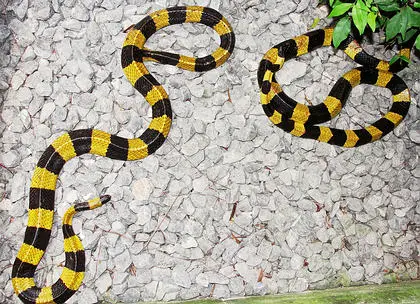
These are yellow and black kraits here in Thailand. In some other part of the world (Borneo) they are black and white. There are also “Blue Kraits“ aka “Malayan Kraits” which are black and white. And the really incredible looking Red-headed Krait which looks nothing like either of them.

Bungarus Fasciatus (Banded Krait)

Thais say: (ngoo sam lee-um, or ngoo kan plong) This is a bit confused in Thailand where, in southern Thailand any viper is known as Ngoo sam lee-um. Lee-um means triangle, and so some people confuse triangle shaped heads of the vipers with triangle cross-section of the kraits.

Length: average 1.5 m up to 2 m (about 6.5 feet) In Thailand they don’t usually reach a full 2 meters.

Range: All over Thailand and most of Asia

Notes: I have yet to see a live banded krait in the wild, except a few dead on the roads – but I don’t go digging up ratholes or termite mounds. I may start if I don’t find one soon. I’ve been looking for three years to find a krait with yellow and black bands like these. At dinner last night I was looking around a small restaurant with many ponds, for snakes. I asked the owner’s son if they had seen any. He said, Ngoo Sam lee-um. That could be the one. I’ll get their permission for some late night herping and try to bag one. I’m sure they’ll appreciate it. This restaurant is located on a small hill close to sea-level in southern Thailand. There are many frogs at the ponds, and probably many snakes too.

Update 2015- I’ve been to that restaurant numerous times and not had a call from them about this krait. I am not sure they have been found in Krabi. I have never found road kill B. fasciatus here in Krabi. I have found a large 2 meter dead on the road banded krait in Surat Thani on the main highway leading to Krabi.

Habitat: This Thailand krait lives on the ground and in rat holes and termite mounds, under stumps or rocks and in other cool, damp places. Recently I saw photos of one in some limestone rocks here in Thailand. They prefer wide open areas near water. They have been found as high as 1,524 meters in Malaysia and about 2,300 meters in Thailand.

Active Time? The snake is mostly nocturnal and is quite active at night. Most bites occur at night, as the kraits move close to people sleeping – usually on the floor, and probably the person moves and the krait bites. More dangerous at night, during the day they are not biters. These kraits are common in the northeast Thailand provinces. Recently a six year old boy was bitten and could not be revived. The snake had come up into their home in Surin to escape some flooding.

Food: Other snakes almost exclusively – rat and cat (Boiga) snakes. In captivity I have seen them eat the following live snakes: Calloselasma rhodostoma, Chrysopelea ornata, and Gonyosoma oxycephalum. One noted herpetologist states that these kraits don’t like to eat water snakes. Will also eat rats, mice, frogs, lizards if snakes cannot be found.

Defensive Behavior: The banded krait is slow acting during the day, lethargic, and usually not interested in striking. However, it can protect itself quite well – it is a strong biter and has been recorded as killing a large type of cattle 60 minutes after a bite.

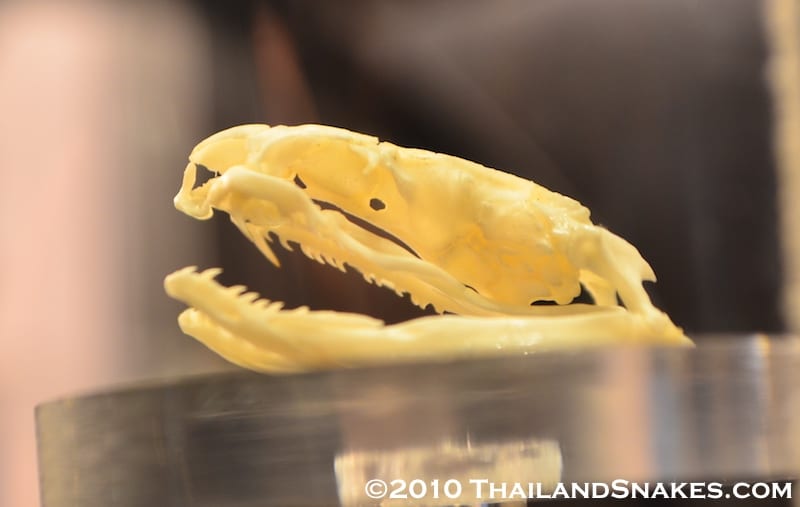
Banded Krait skull showing fangs, jaw, and other dentition. Skull located at Queen Saovabha Memorial Institute in Bangkok, Thailand.

Venom Toxicity: Very toxic. Deadly. This yellow/black banded krait from Thailand appears to have venom that is very toxic to humans. The typical LD-50 studies to assess the toxicity of venom in mice, rate this as a very toxic venom as well. These snakes rarely bite during the day, but if they do, they can transfer enough venom to kill you. I read about a person dying in 30 minutes, and another dying in 15 hours. A famous American herpetologist, Joe Slowinski, was killed by a baby krait (Bungarus multicinctus) in Burma while on a remote expedition. They can be quite deadly. The cause of death is that your muscles are paralyzed and your diaphragm can’t work any longer to pull oxygen into your lungs. Kraits are very deadly in this regard. However, if you are able to get to a hospital with a ventilator you will likely be OK. There is no specific antivenin for snake bites from this snake, but polyvalent venom is used – which can also treat bites from Naja kaouthia and Ophiophagus hannah.

Interesting to note… when fed on a live garter snake the krait venom acts instantly to cause death. Apparently krait venom is very efficient with snakes – the krait’s primary diet.

Handling: The banded and Malayan blue kraits are not known to bite during the daytime. However, at night time they bite rather easily, as evidenced by the numerous krait bites that occur at night to people usually laying down to sleep on the floor either outdoors or in their homes with the door open. I would never handhold kraits like the man is doing in the photo above. The krait venom is so toxic, it’s just not worth the risk – however small.

Update: I was contacted by a man who was bitten by this same type of krait during the day at an impromptu show at a bar in Bangkok during the daytime. It bit his arm. He was lucky to live, and had lingering effects for more than two years after the bite.

Antivenin:  Polyvalent. It is advised by experts to get antivenin in your blood stream for krait bites before you have symptoms because, once symptoms develop you may have lost nerve functioning that will likely not return.

Offspring: Mating in March-April and 4-14 eggs laid about 60 days afterward. The mother krait remains with the eggs for another 60 days before they hatch. Baby kraits are about 30cm long at birth, and have venom. I couldn’t find in the literature whether the mother left the eggs as they started hatching – so she didn’t eat them herself or not. The King Cobra does this instinctively because it also eats other snakes.

Banded Krait Scientific Classification

Kingdom: Animalia
Phylum: Chordata
Subphylum: Vertebrata
Class: Reptilia
Order: Squamata
Suborder: Serpentes
Family: Elapidae
Genus: Bungarus
Species: B. fasciatus

Binomial name
Bungarus fasciatus
Classified by Schneider in year 1801

Photo of Two Adult Banded Kraits: